

Dr. Suzanne McMurry, N.D., F.A.B.N.O.
Integrative oncologist and naturopathic physician who completed an accredited hospital-based integrative oncology residency. She is a Fellow of the American Board of Naturopathic Oncology and provides evidence-based support before, during, and after cancer treatment.
Last reviewed: August 31, 2026
Every so often a study comes along that changes what we’re allowed to say in clinic. For years, those of us in integrative oncology have told patients that exercise after treatment was associated with better outcomes, always with the careful caveat: “but that’s observational data; we can’t prove the exercise is doing it.”
The CHALLENGE trial retired that caveat.
In plain terms: CHALLENGE was a large randomized trial showing that colon cancer survivors who followed a structured exercise program after chemotherapy lived longer and had fewer recurrences than those who didn’t. Not “felt better,” although they did that too. Lived longer. It is the strongest evidence we have ever had that exercise functions as a cancer treatment, not just a quality-of-life add-on.
Most coverage of the trial has been either breathless (“exercise beats chemo!” — no) or buried in academic hedging. As a naturopathic oncologist, my job is the middle path: what the study actually found, what it doesn’t prove, and what you can do with it, starting this week.
TL;DR: The CHALLENGE trial in four sentences
- Colon cancer survivors who completed a 3-year structured exercise program after chemotherapy had meaningfully higher disease-free survival and overall survival than those given health education alone.
- The “dose” was achievable: roughly a brisk 45-minute walk, 3 to 4 times per week, sustained over time, with coaching support.
- The trial was in colon cancer, so for other cancers it is powerful supporting evidence rather than proof.
- The practical takeaway is the same for nearly everyone: a structured, consistent, modest exercise habit is one of the most potent things you can do for survivorship, and it is never too late to start.
What the CHALLENGE Trial Actually Did
The Colon Health and Life-Long Exercise Change trial (yes, someone worked hard on that acronym) followed colon cancer patients who had finished surgery and adjuvant chemotherapy, the group whose biggest remaining question is “will it come back?”
Researchers randomized roughly 890 patients to one of two groups:
- The exercise group got a structured program: a personal physical activity consultant, a tailored exercise plan, and regular coaching sessions over three years. The target was a sustained increase in weekly aerobic activity, the equivalent of adding about 3 to 4 brisk 45-to-60-minute walks per week.
- The comparison group received standard health education materials promoting exercise and healthy eating, which, notably, is more than many patients get.
Then they followed everyone for years. This design matters: it’s the difference between “people who exercise do better” (which could just mean healthier people exercise more) and “being assigned to exercise made people do better.” CHALLENGE is the second kind, a randomized phase 3 trial, the same standard of evidence we demand from drugs.
What It Found
Two headline results, published in the New England Journal of Medicine in 2025:
- Fewer recurrences. Disease-free survival at five years was about 80% in the exercise group versus about 74% in the comparison group, roughly a 28% reduction in the risk of recurrence, new cancer, or death.
- Longer lives. Overall survival at eight years was about 90% in the exercise group versus about 83%, roughly a 37% reduction in the risk of death.
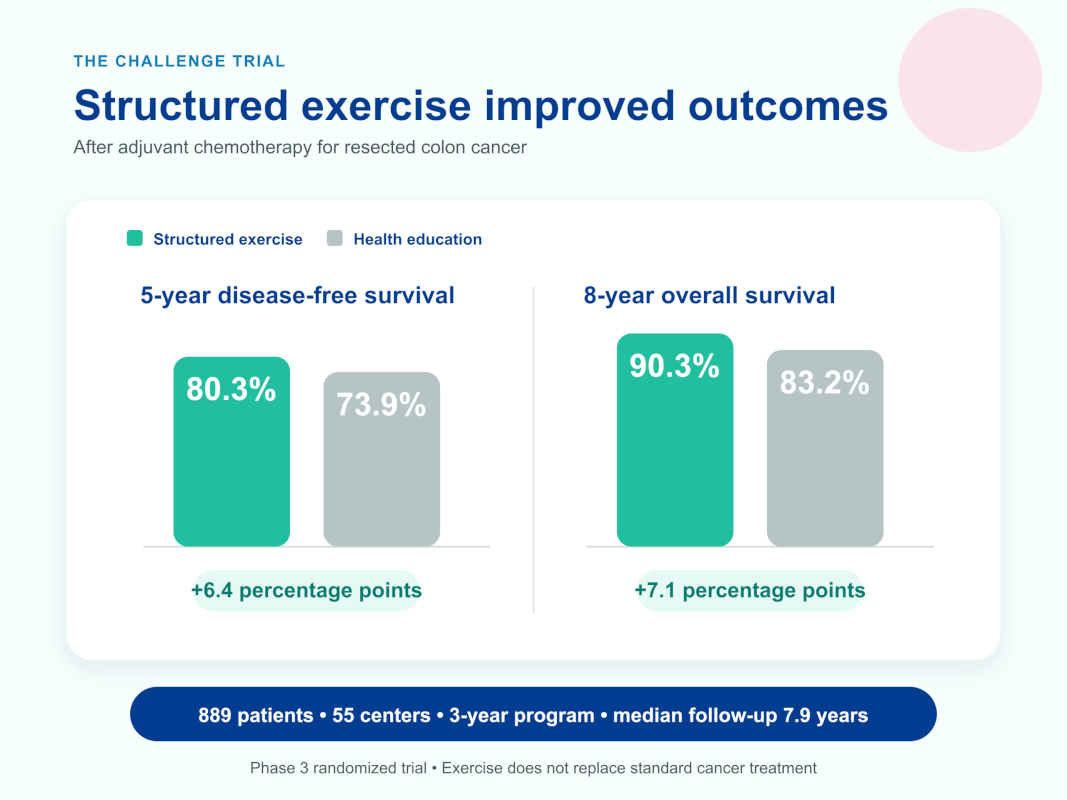
To put that in perspective: those numbers are in the same range as the benefit we expect from some adjuvant chemotherapy regimens. When oxaliplatin was added to standard chemo for colon cancer years ago, it changed practice worldwide on the strength of a comparable absolute benefit. The exercise program produced its benefit with side effects like “better fitness” and “improved mood.”
That’s the part worth sitting with. Not exercise instead of chemotherapy; these patients had already completed chemo. Exercise after treatment, as its own additional layer of protection.
What This Study Does NOT Tell Us
This is the section the breathless headlines skip, so let’s be precise:
- It’s a colon cancer trial. The randomized proof applies to colon cancer survivors after adjuvant chemo. For breast, prostate, lung, and other cancers we have large, consistent observational data linking activity to lower recurrence and mortality, plus randomized trials showing exercise improves fatigue, cognition, treatment tolerance, and quality of life. Strong supporting evidence, but CHALLENGE-level proof exists today only for colon cancer.
- It doesn’t replace treatment. Ever. Participants completed surgery and chemotherapy first. Anyone using this trial to argue for skipping conventional treatment is misreading it badly, and that misreading is dangerous.
- It tested a program, not just movement. Participants got coaching, accountability, and a plan that adapted over three years. The lesson isn’t “buy a treadmill”; it’s that structure and support are part of the medicine.
- It’s a starting dose, not a ceiling or a floor. The trial’s target was moderate. What we know works is the consistent, modest, sustained dose.
The Prescription, Translated
Here’s the trial’s intervention converted into something you can actually do. The target:
- Aim for the equivalent of 3 to 4 brisk 45-to-60-minute walks per week. “Brisk” means you’re slightly breathless but can still hold a conversation.
- Walking is the proven default, but the currency is effort, not steps. Cycling, swimming, dancing, hiking, rowing: anything aerobic at conversational-but-breathy intensity counts.
- Add 2 short strength sessions per week (bands, bodyweight, light weights). This wasn’t CHALLENGE’s focus, but it’s standard exercise oncology guidance and protects the muscle and bone your recovery depends on.
Modifications that make it work in the real world:
- Starting from deconditioned: begin at 10 to 15 minutes at whatever pace you have, and add 5 minutes per week.
- Neuropathy in the feet: stable surfaces, supportive shoes, and consider a stationary bike or pool walking.
- Joint pain on aromatase inhibitors: warm up longer and favor low-impact options.
- Bone metastases or significant bone thinning: ask for an oncology-trained physical therapist referral before starting.
Your 12-Week Restart Plan
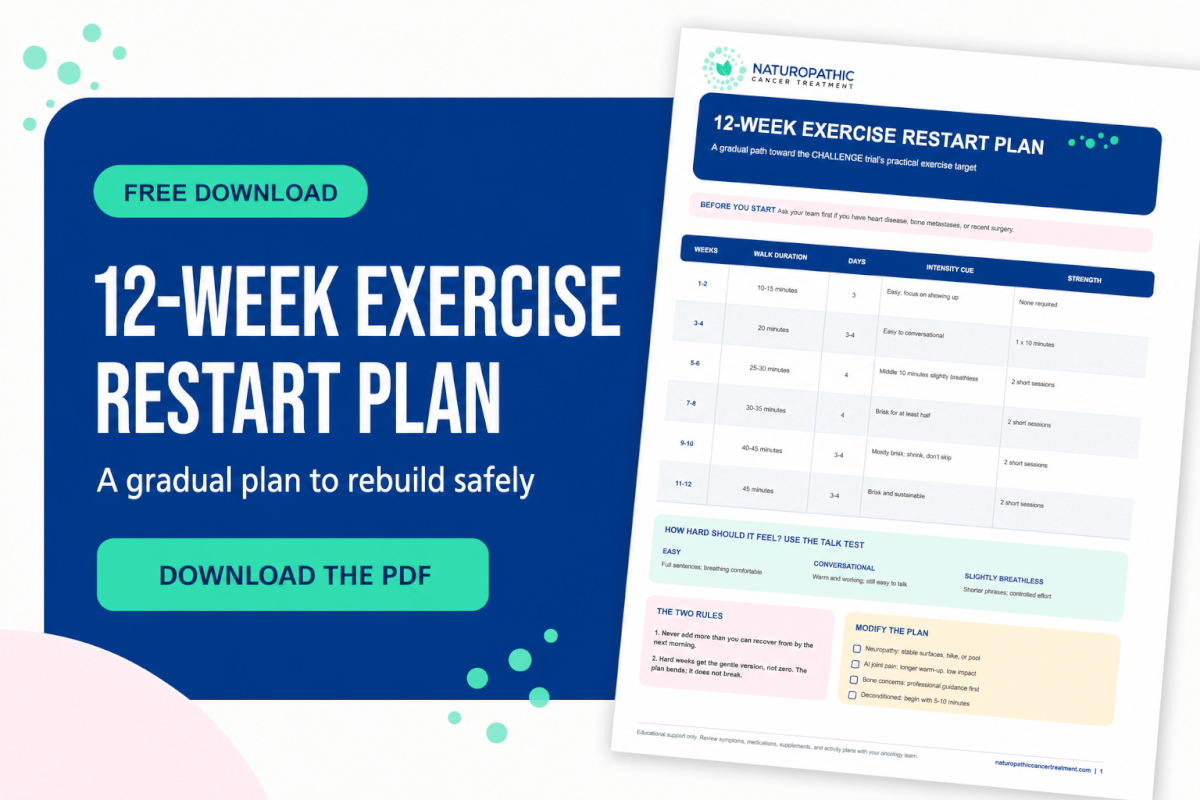
A gradual on-ramp to the trial’s target, designed for someone starting from “treatment ended and I’ve barely moved since.”
Before starting, check with your care team if you have a heart condition, bone metastases, or recent surgery so the plan can be adapted safely.
Weeks 1-2: Re-introduce. Walk 10 to 15 minutes, 3 days this week, at an easy pace. The goal is showing up, not speed.
Weeks 3-4: Stabilize. Walk 20 minutes, 3 to 4 days per week. Add one 10-minute strength session: sit-to-stands from a chair, wall push-ups, and a light band row.
Weeks 5-6: Build. Walk 25 to 30 minutes, 4 days per week, and on two of them push the middle 10 minutes to “slightly breathless.” Strength moves to 2 short sessions per week.
Weeks 7-8: Consolidate. 30 to 35 minute walks, 4 days per week, brisk for at least half. Keep both strength sessions.
Weeks 9-10: Approach the dose. Three to four walks of 40 to 45 minutes, mostly brisk.
Weeks 11-12: Arrive. You’re at or near the CHALLENGE target: 3 to 4 brisk 45-minute sessions plus 2 strength sessions per week.
Two rules across all twelve weeks: never increase by more than you can recover from by the next morning, and on low-energy days do the gentlest version rather than none.
You Weren’t Meant to Do This Alone (Neither Were the Trial Participants)
Remember: CHALLENGE participants had a physical activity consultant and three years of coaching. Structure and accountability were part of the intervention. Your version of that support might be:
- An oncology-trained exercise professional. Look for the ACSM/ACS Certified Cancer Exercise Trainer credential, or ask your cancer center about exercise oncology programs.
- An oncology-trained physical therapist, especially if neuropathy, bone concerns, surgery recovery, or deconditioning make starting feel risky.
- A standing date. A neighbor, walking group, or survivor program can make consistency easier.
- An integrative care plan that makes exercise possible. Fatigue, joint pain, neuropathy, poor sleep, and low iron are treatable barriers.
Why People Stall, and What Helps
- “I’m too exhausted.” Start with five minutes. Read my complete guide to cancer-related fatigue, and have profound exhaustion evaluated.
- “It hurts.” Low-impact options and longer warm-ups can bend the plan without canceling it. New, focal, or worsening pain needs a call to your team first.
- “I’m afraid I’ll hurt myself.” A supervised start with a PT or cancer exercise trainer converts fear into confidence.
- “I don’t have time.” The dose is about three hours per week. Two 20-minute walks count more than one 45-minute walk that never happens.
Frequently Asked Questions About the CHALLENGE Trial and Exercise
What did the CHALLENGE trial show?
CHALLENGE was a randomized phase 3 trial of about 890 colon cancer survivors who had completed surgery and chemotherapy. Those assigned to a three-year structured exercise program had higher disease-free survival and overall survival than those given health education materials alone.
Can exercise really prevent cancer recurrence?
For colon cancer, CHALLENGE provides randomized evidence that a structured exercise program reduces recurrence risk. For other cancers, the evidence is strong and supportive but not yet CHALLENGE-level proof.
How much exercise do cancer survivors need?
Roughly 3 to 4 brisk 45-to-60-minute walks per week, plus 2 strength sessions, aligns with the trial and exercise oncology guidance. Start far below that if you need to.
Is it safe to exercise after cancer treatment?
For most survivors, yes. Specific situations such as bone metastases, severe neuropathy, heart conditions, or very low blood counts call for a tailored plan and supervision.
Does this mean exercise works better than chemotherapy?
No. Participants had already completed chemotherapy; exercise added benefit on top of it.
I had a different cancer. Does CHALLENGE apply to me?
The randomized proof is specific to colon cancer, but exercise benefits for fatigue, cognition, mood, and treatment tolerance apply across cancer types.
The Most Encouraging Trial in Years
Cancer survivorship is full of things you can’t control. CHALLENGE handed survivors something they can: a specific, achievable, drug-free intervention with phase 3 evidence behind it, one that also happens to improve fatigue, brain fog, sleep, and mood.
If symptoms or uncertainty are standing between you and week one, that’s a solvable problem. Building a safe, personalized exercise foundation is exactly the kind of work I do with survivors every week.
Schedule a virtual consult to build your post-treatment exercise plan, and recover better, faster:
References
- Courneya KS, Vardy JL, O’Callaghan CJ, et al.; CHALLENGE Investigators. Structured Exercise after Adjuvant Chemotherapy for Colon Cancer. N Engl J Med. 2025;393(1):13–25. doi:10.1056/NEJMoa2502760.
- Campbell KL, Winters-Stone KM, Wiskemann J, et al. Exercise Guidelines for Cancer Survivors: Consensus Statement from International Multidisciplinary Roundtable. Med Sci Sports Exerc. 2019;51(11):2375–2390. PMID: 31626055.
- Holmes MD, Chen WY, Feskanich D, Kroenke CH, Colditz GA. Physical activity and survival after breast cancer diagnosis. JAMA. 2005;293(20):2479–2486. PMID: 15914748.
- Kenfield SA, Stampfer MJ, Giovannucci E, Chan JM. Physical activity and survival after prostate cancer diagnosis in the Health Professionals Follow-Up Study. J Clin Oncol. 2011;29(6):726–732. PMID: 21205749.
- ClinicalTrials.gov. NCT00819208: Colon Health and Life-Long Exercise Change (CHALLENGE).
- American College of Sports Medicine. Exercise and Cancer resources.