

Dr. Suzanne McMurry, N.D., F.A.B.N.O.
Integrative oncologist and naturopathic physician who completed an accredited hospital-based integrative oncology residency. She is a Fellow of the American Board of Naturopathic Oncology and provides evidence-based support before, during, and after cancer treatment.
Last reviewed: September 1, 2026
You slept nine hours and woke up exhausted. You showered and needed to sit down afterward. The tiredness doesn’t lift with coffee, doesn’t respond to rest, and doesn’t care what you have planned today. And when you mentioned it at your last appointment, you got a sympathetic nod and not much else.
Let’s take it more seriously than that, because it deserves it.
Cancer-related fatigue is a persistent, whole-body exhaustion caused by cancer and its treatment that is out of proportion to your activity and doesn’t resolve with rest. More than 80% of people receiving chemotherapy or radiation experience it during treatment, and here is the part too few patients hear: it is treatable. Exercise, sleep care, targeted nutrition, and treating the hidden contributors (like anemia and thyroid issues) each measurably reduce fatigue, and they stack.
I’m Dr. Suzanne McMurry, a naturopathic oncologist, and helping patients get their energy back is some of the most satisfying work I do. This guide is the complete picture: why cancer fatigue happens, what the current evidence actually supports, and how to build your way back to feeling like yourself.
TL;DR: What helps cancer fatigue most
Ranked by how reliably they work:
- Movement, gently and consistently. Exercise is one of the best-supported non-drug strategies for cancer fatigue. Start tiny, build gradually, and scale it to what is safe and appropriate for you.
- Rule out the fixable causes. Based on your symptoms, treatment history, and risk factors, your care team may consider anemia, iron status, vitamin B12, vitamin D, thyroid function, sleep problems, pain, mood, medication effects, and other causes.
- Mind-body therapies with real evidence. Cognitive behavioral therapy (CBT) and mindfulness programs are guideline-recommended, not fluff.
- Protect sleep, but don’t over-rest. Broken sleep feeds fatigue, yet spending more hours in bed usually makes it worse. The goal is better sleep, not more bed.
- Eat for steady energy. Regular protein, slow carbohydrates, and hydration. Skipped meals are stolen energy.
Mindset shift: pushing through on good days and crashing for three days after is the classic trap. Pace, don’t push.
Don’t miss the Cancer Fatigue Action Plan, a free download to put everything into action available below.
Why Am I So Tired? This Isn’t Normal Tiredness
The first thing to understand is that cancer-related fatigue (your care team may call it CRF) is not regular tiredness scaled up. It’s a different physiological state, which is why naps and weekends off don’t fix it.
Here’s what’s actually happening in your body:
- Inflammation. Cancer and its treatments trigger inflammatory signaling throughout the body. Those same inflammatory messengers act directly on the brain to produce fatigue, the same biology that flattens you during a bad flu.
- Mitochondrial stress. Your mitochondria are the power plants inside every cell. Chemotherapy and radiation damage them as collateral, so your cells are quite literally producing less energy.
- Anemia. Many treatments suppress red blood cell production. Fewer red blood cells means less oxygen delivered everywhere, and fatigue is the first symptom.
- Direct treatment effects. Radiation fatigue accumulates over a course of treatment. Chemo fatigue often cycles with infusion timing. Immunotherapy can produce inflammation-driven fatigue, and endocrine therapies change the hormonal landscape your energy depends on.
- The pile-on. Poor sleep, pain, stress, anxiety, low mood, weight loss, and deconditioning each add their own layer. By the time fatigue shows up in clinic, it’s usually several problems wearing one coat.
That last point is the most important one. Because fatigue is usually a pile-up, there is almost never one magic fix, but there are almost always several things that each help. The plan is to stack them.
What the SIO/ASCO Fatigue Guideline Recommends
In 2024, the Society for Integrative Oncology and the American Society of Clinical Oncology published a joint clinical practice guideline on managing cancer-related fatigue. This matters because it’s mainstream oncology and integrative oncology agreeing, in writing, on what works. In plain language, here’s what they found the evidence supports:
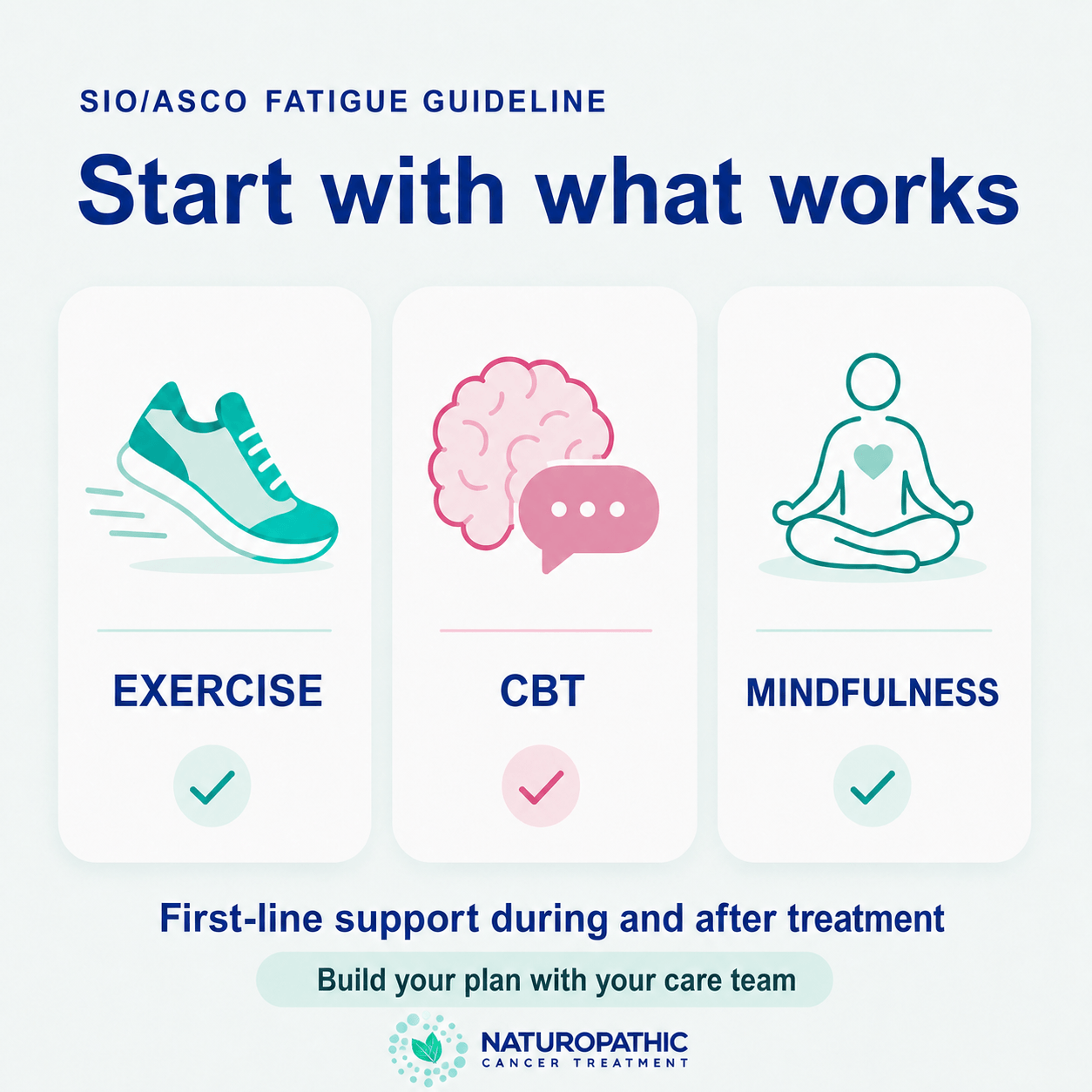
Recommended, with the strongest evidence:
- Exercise — during treatment and after. One of the most consistently supported non-drug interventions studied, when medically appropriate.
- Cognitive behavioral therapy (CBT) — structured psychological therapy that reduces fatigue, not just distress about fatigue.
- Mindfulness-based programs — meditation-based stress reduction courses with solid trial evidence.
Reasonable options with supporting evidence:
- Yoga, tai chi, and qigong — gentle movement practices that pull double duty as exercise and stress care.
- American ginseng — one of the few supplements with positive randomized trial data during treatment (more below).
- Acupressure — for fatigue after treatment.
What the guideline points away from:
- Relying on rest alone to fix fatigue. It doesn’t, and excessive rest deconditions you further.
- L-carnitine supplements for fatigue. Trials were disappointing (this surprises many of my patients; details below).
- Routine use of stimulant medications for fatigue outside specific situations. Evidence doesn’t support them as a general fix.
For your next appointment, you can ask: “The SIO/ASCO guideline recommends exercise, CBT, and mindfulness as first-line treatments for cancer-related fatigue. Can we talk about how I access those?”
Exercise: One of the Best-Supported Strategies
I know how it sounds. You can barely get off the couch and the prescription is movement. Across randomized trials, exercise is one of the most consistently supported non-drug strategies for cancer-related fatigue, and a major meta-analysis also supports psychological interventions. That does not make exercise universally better than medication or appropriate at the same intensity for everyone; the plan should be individualized around treatment status, symptoms, mobility, and safety. The effect shows up during treatment, after treatment, and in advanced disease.
And if fatigue relief alone isn’t enough to get you moving, here’s the kicker: the 2025 CHALLENGE trial showed that colon cancer survivors who followed a structured exercise program after chemotherapy had meaningfully better disease-free survival. That trial wasn’t about fatigue, but it changed the conversation: the same walks that rebuild your energy may also be working on the outcome you care about most. The effort pays twice. I’ve written a full plain-English breakdown in my CHALLENGE trial guide.
The target (where we’re heading, not where you start):
- 150 minutes per week of moderate aerobic activity. Brisk walking absolutely counts.
- Plus 2 strength sessions per week. Muscle is your metabolic reserve; treatment steals it, and strength work takes it back.
How to scale it by where you are:
- In active treatment: the goal is consistency, not volume. Five to ten minutes of walking most days is a legitimate, evidence-supported dose. On infusion weeks, do less, but try not to do nothing; even gentle movement protects you from the deconditioning spiral.
- Just finished treatment: build gradually. Add five minutes to your walks each week, and introduce light resistance work (bands, bodyweight) twice weekly.
- Months out and still fatigued: this is where structured, progressive exercise shines, and where an oncology-trained physical therapist or exercise specialist can be especially valuable.
The pacing rule that protects you:
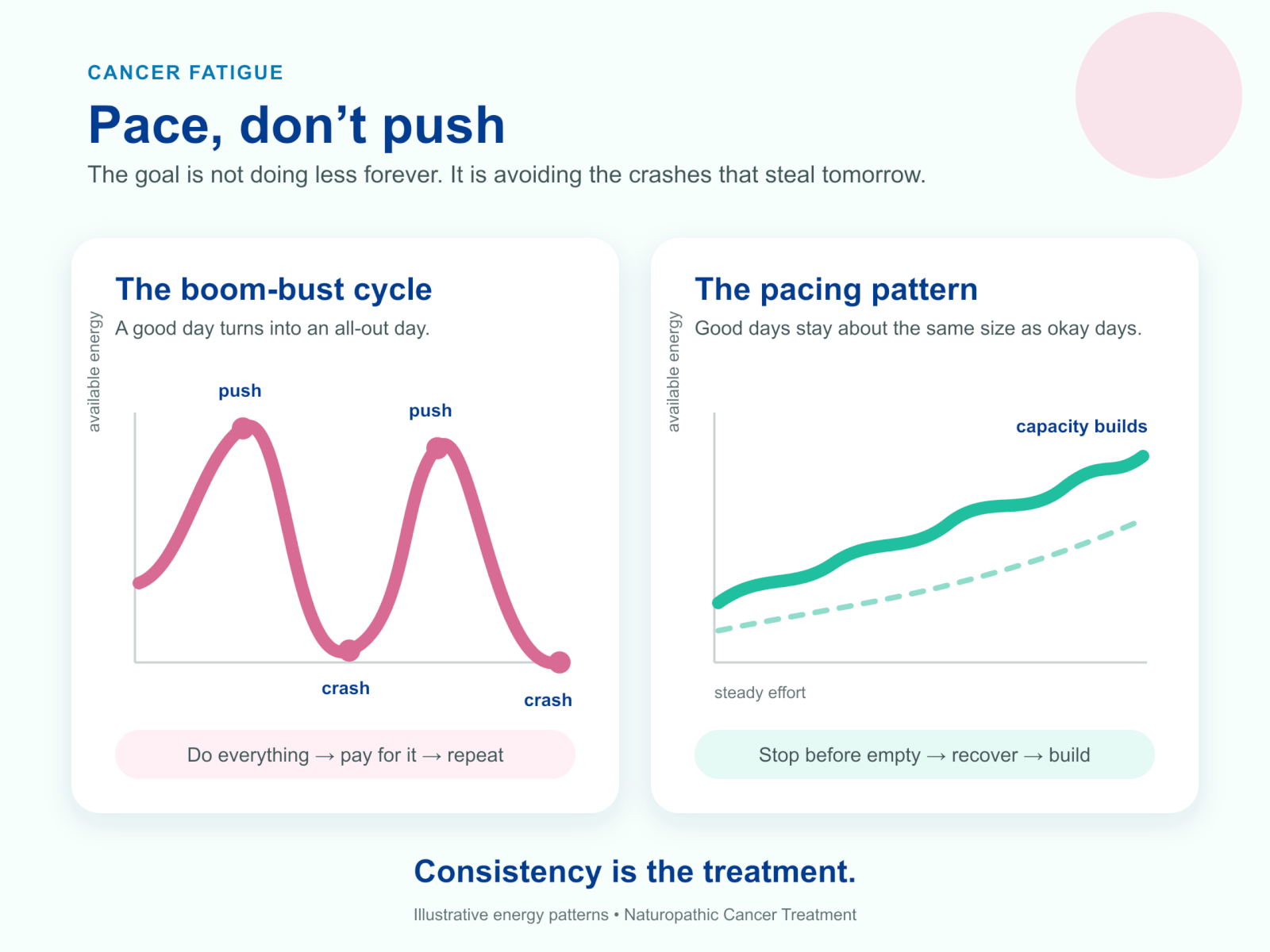
The classic fatigue trap is the boom-bust cycle: you feel decent on Tuesday, do everything, and lose Wednesday through Friday. The fix is pacing. Decide your activity level by plan, not by how good you feel in the moment, and keep it close to what worked yesterday. Steady inputs, steady energy.
The Sleep-Fatigue Loop
Fatigue and bad sleep feed each other. Daytime exhaustion leads to naps and extra hours in bed, which fragments nighttime sleep, which deepens the next day’s fatigue. Two rules break the loop:
- Protect the night. Consistent sleep and wake times, a real wind-down, and if naps are necessary, keep them short (20 to 30 minutes) and before mid-afternoon. My guide to sleep during cancer treatment covers the foundations.
- Don’t expand the bed. Spending 10 to 12 hours in bed chasing rest usually delivers lighter, more broken sleep and groggier days. Quality over quantity, every time.
If your sleep problem has hardened into true insomnia (awake at 3am, night after night), that’s its own treatable condition and worth its own attention from your care team. My guide to cancer-related insomnia explains how to match the treatment to what is keeping you awake.
Eat for Energy: The Nutrition Layer
Treatment raises your body’s nutritional demands at the exact moment it wrecks your appetite. A few principles do most of the work:
- Protein at every meal. Muscle loss is a major fatigue driver, and most patients in treatment under-eat protein. Aim for a palm-sized portion (or a smoothie scoop) at each meal.
- Slow carbohydrates over sugar hits. Oats, beans, lentils, whole grains, and fruit deliver steady glucose. Sugar spikes feel like energy and collect the debt an hour later.
- Hydrate on a schedule. Even mild dehydration amplifies fatigue. Keep water in reach all day; don’t wait for thirst.
- Small and frequent beats big and rare. If appetite is poor, five small eating moments out-deliver three meals you can’t finish.
I’ve written a full deep-dive on this with specific foods, meal ideas, and recipes: Fight Fatigue with Food: The Keys to Boosting Your Energy Consistently. Consider it the companion piece to this guide.
Do Supplements Help Cancer Fatigue? The Honest Rundown
Same two rules as always in my practice: clear everything with your oncology team before starting (interactions with chemo, immunotherapy, and hormone therapy are real), and check anything against the MSKCC About Herbs database. With that said, here’s the evidence picture:
| Supplement | Evidence for cancer fatigue | My take |
|---|---|---|
| American ginseng | Positive randomized trial: 2,000 mg daily reduced fatigue during treatment over 8 weeks | The best-supported option; discuss first if you have hormone-sensitive cancer or take blood thinners |
| B12 | Clear benefit if you’re deficient; none if you’re not | Test, don’t guess; deficiency is common and mimics CRF exactly |
| Vitamin D | Low levels are linked with worse fatigue; correction helps the deficient | Another test-first nutrient; most of my patients test low, especially in northern latitudes |
| CoQ10 | Mixed trials; biologically sensible for mitochondrial support but unproven for CRF | Reasonable to discuss, not a cornerstone; flag if you’re on blood thinners |
| Magnesium | Indirect support via sleep and muscle function | Glycinate form, 200 to 400 mg in the evening, is a gentle ally |
| L-carnitine / acetyl-L-carnitine | Randomized trial evidence was negative; guideline points away from it | I don’t recommend it for fatigue, and it surprises people how often it’s still sold for this |
| High-dose stimulant “energy” blends | No good evidence, real interaction risk | Skip them |
The bigger supplement insight is this: the most powerful “supplement” for fatigue is correcting an actual deficiency. Which brings us to the conversation almost nobody has.
The Anemia and Iron Conversation Your Fatigue Deserves
“Your counts are fine” does not always answer every question about fatigue, but testing should be guided by your symptoms, treatment history, and risk factors.
Ask your oncology team whether any of the following are appropriate for you:
- CBC (complete blood count) — commonly used to evaluate anemia, which treatment can cause.
- Ferritin and other iron studies — may help when iron deficiency is plausible; results need clinical interpretation.
- B12 and folate — may be relevant when symptoms, diet, medications, or treatment history suggest risk.
- Vitamin D — may be considered when deficiency risk or related symptoms are present.
- TSH (thyroid) — can be important with symptoms or treatments, including some immunotherapies, that affect thyroid function.
Not every test is necessary for every person. The useful question is which contributors fit your symptoms and treatment history, and how any result would change the plan.
When Fatigue Is a Red Flag
Most cancer-related fatigue is miserable but not dangerous. Sometimes, though, it’s the messenger for something that needs prompt attention.
Call immediately or go to the ER:
- If you are receiving chemotherapy and have a temperature of 100.4°F (38°C) or higher. Fever during chemotherapy is a medical emergency because it may be the only sign of a life-threatening infection. Call your oncology team immediately; if you cannot reach them promptly, go to the ER and tell staff you are receiving chemotherapy.
- New or severe breathlessness, chest pain, fainting, or a racing heart at rest. These can signal a blood clot, severe anemia, or a cardiac problem and need urgent evaluation.
Contact your care team today:
- Breathlessness with mild activity, new dizziness, or marked pallor (noticeably pale skin, lips, or nail beds)
- Sudden, dramatic worsening of fatigue rather than the usual slow grind
- Other signs of infection, including chills, a new cough, painful urination, or redness around a port or wound, even without a measured fever
Raise at your next appointment:
- The depression overlap: if you’ve lost interest in things you normally care about, feel hopeless, or your sleep and appetite have shifted alongside the exhaustion, please say so out loud. Depression and fatigue travel together in cancer care, each makes the other worse, and both are treatable. Asking for help with this is a clinical request, not a character flaw. If you feel you may harm yourself or cannot stay safe, call emergency services or go to the ER now.
Your Energy Comeback Plan
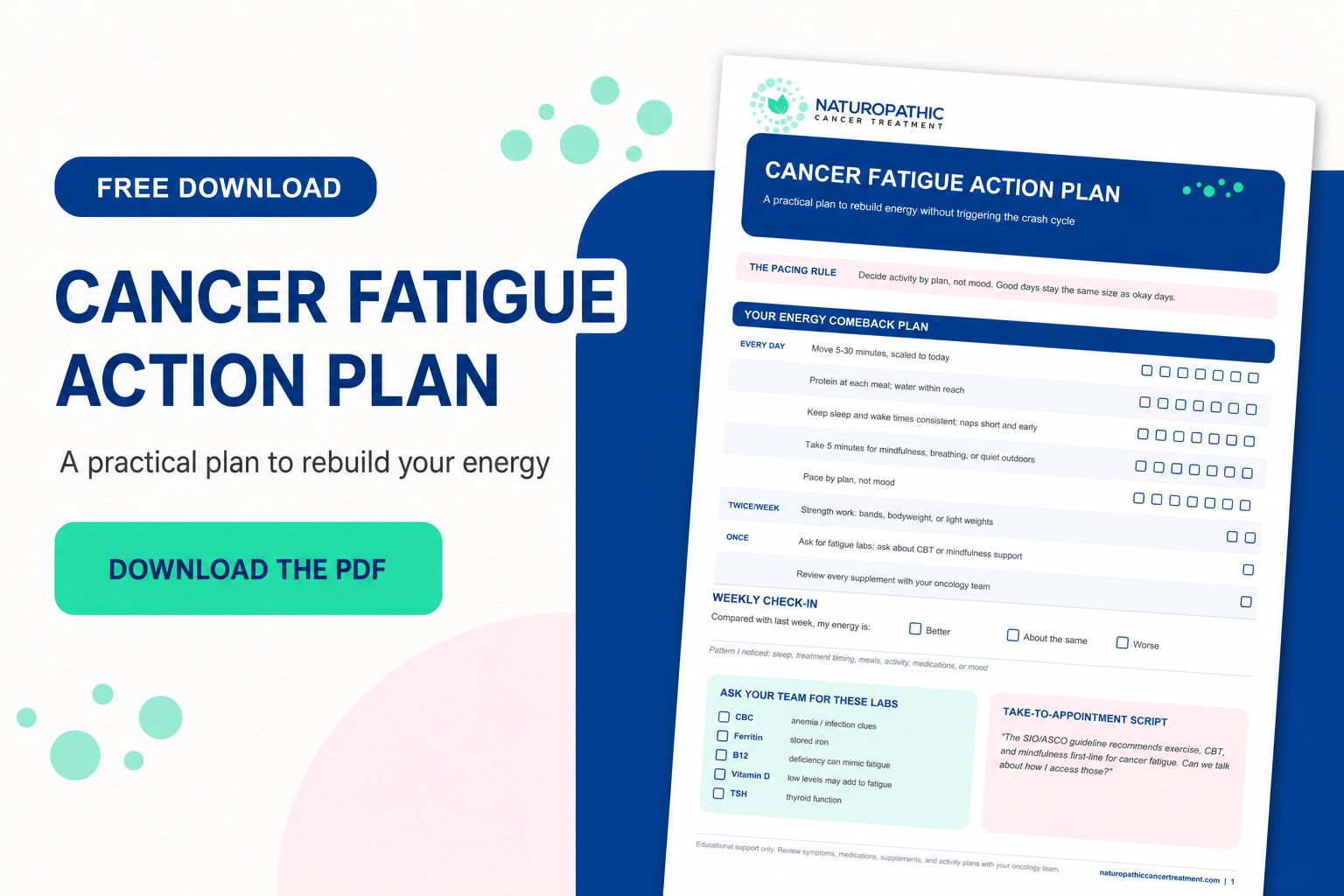
The condensed version for day-to-day use. Start with one or two items, not all of them:
Every day:
- Move: 5 to 30 minutes, scaled to your treatment phase. Something is always better than nothing.
- Protein at each meal; water within reach all day
- Consistent sleep and wake times; naps short and early
- 5 minutes of mindfulness, breathing, or quiet time outdoors
- Pace by plan, not by mood: keep good days the same size as okay days
Twice a week:
- Strength work: bands, bodyweight, or light weights
Once:
- Ask your team whether testing such as a CBC, ferritin or other iron studies, B12/folate, vitamin D, or TSH fits your symptoms, treatment history, and risk factors
- Ask about CBT or a mindfulness program for fatigue (guideline-recommended, often covered)
- Review every supplement you take with your oncology team or a naturopathic oncologist
Each week:
- A quick check-in: is this week’s energy trending better than last week’s? Track it alongside sleep, activity, and meds; patterns are how we find your levers.
Frequently Asked Questions About Cancer Fatigue
Why am I so tired with cancer?
Cancer-related fatigue is driven by inflammation, reduced cellular energy production (mitochondrial stress), anemia, and the direct effects of treatment, with sleep problems, stress, pain, and deconditioning stacked on top. It’s a physiological state, not a willpower problem, and it’s not proportional to how much you’ve rested.
How long does cancer fatigue last?
Fatigue typically peaks during treatment and improves over the weeks to months afterward. Most people feel substantially better within 6 to 12 months of finishing treatment. Roughly a quarter to a third of survivors have fatigue that persists longer, and that persistent fatigue still responds to exercise, CBT, mindfulness, and correction of contributors like anemia, low iron, and thyroid dysfunction.
What is the best treatment for cancer-related fatigue?
Exercise is one of the best-supported non-drug strategies and is recommended by the SIO/ASCO guideline, alongside cognitive behavioral therapy and mindfulness-based programs. Medication and symptom-management needs are individualized. A practical plan may combine gradual activity, sleep care, steady nutrition, stress care, and a clinician-guided discussion of testing when symptoms or treatment history suggest potentially fixable contributors.
Do any supplements actually help cancer fatigue?
American ginseng (2,000 mg daily) has the best randomized trial support during treatment. B12 and vitamin D help when you’re deficient, which is common. CoQ10 evidence is mixed. L-carnitine, despite being heavily marketed for energy, did not work in trials and isn’t recommended. Screen everything with your oncology team first.
Does cancer fatigue mean my cancer is getting worse?
Usually not. Fatigue is overwhelmingly a side effect of treatment and the body’s inflammatory response, and it commonly persists long after successful treatment. But a sudden, marked worsening of fatigue needs same-day attention, and fever during chemotherapy or fatigue with chest pain, severe breathlessness, fainting, or a racing heart at rest needs immediate evaluation.
Does radiation cause fatigue, and how long does radiation fatigue last?
Yes. Radiation fatigue often builds gradually over the course of treatment and can be strongest near the end or in the first weeks afterward. It commonly begins to improve after treatment ends, but recovery can take weeks to months depending on the treatment area, dose, other therapies, and your overall health.
Should I rest more or push through?
Often neither extreme. Too much rest can contribute to deconditioning, while pushing through on good days can trigger a boom-bust crash cycle. A safer middle path is pacing: a consistent, modest activity level that grows slowly, with adjustments for treatment phase, symptoms, and medical guidance.
Is cancer fatigue the same as chemo brain?
They’re different but deeply connected: the fog of chemo brain and the heaviness of fatigue share inflammatory drivers, and each makes the other worse. The good news is the levers overlap too; exercise, sleep, and treating anemia improve both.
You Can Get Your Energy Back
The core message is that cancer fatigue is real, it’s physiological, and it responds to treatment. Not instantly, and not from any single fix, but reliably, when you stack the right pieces and give them weeks instead of days.
In my naturopathic oncology practice, fatigue is one of the most common reasons patients reach out. We look for the factors that can actually be changed: the labs worth running, supplements screened against your treatment, and an exercise plan scaled to your real energy rather than an idealized baseline.
If exhaustion is shrinking your life, let’s build your comeback plan together.
Schedule a virtual consult for cancer fatigue support with Dr. McMurry:
References
- Bower JE, Lacchetti C, Alici Y, et al. Management of fatigue in adult survivors of cancer: ASCO-Society for Integrative Oncology guideline update. Journal of Clinical Oncology, 2024. The guideline summarized in this article.
- Mustian KM, Alfano CM, Heckler C, et al. Comparison of pharmaceutical, psychological, and exercise treatments for cancer-related fatigue: a meta-analysis. JAMA Oncology, 2017. Exercise and psychological interventions outperformed drug options.
- National Cancer Institute. Fatigue and Cancer. Source for the prevalence figure in the opening.
- Barton DL, Liu H, Dakhil SR, et al. Wisconsin ginseng (Panax quinquefolius) to improve cancer-related fatigue: a randomized, double-blind trial, N07C2. Journal of the National Cancer Institute, 2013. The American ginseng trial.
- Cruciani RA, Zhang JJ, Manola J, et al. L-carnitine supplementation for the management of fatigue in patients with cancer: an Eastern Cooperative Oncology Group phase III, randomized, double-blind, placebo-controlled trial. Journal of Clinical Oncology, 2012. The negative L-carnitine trial.
- Bower JE. Cancer-related fatigue: mechanisms, risk factors, and treatments. Nature Reviews Clinical Oncology, 2014. Persistence of fatigue in survivors, and inflammation as a driver.
- Courneya KS, Vardy JL, O’Callaghan CJ, et al. Structured exercise after adjuvant chemotherapy for colon cancer. New England Journal of Medicine, 2025. The CHALLENGE trial.
- Campbell KL, Winters-Stone KM, Wiskemann J, et al. Exercise guidelines for cancer survivors: consensus statement from International Multidisciplinary Roundtable. Medicine & Science in Sports & Exercise, 2019. Source of the 150-minute and twice-weekly strength targets. See also ACSM’s cancer and exercise resources.
- National Comprehensive Cancer Network. NCCN Guidelines for Patients: Fatigue and Cancer, 2024.
- Centers for Disease Control and Prevention. Watch Out for Fever. The 100.4°F threshold during chemotherapy.
- Memorial Sloan Kettering Cancer Center. About Herbs, Botanicals & Other Products. Supplement safety and interaction screening.