

Dr. Suzanne McMurry, N.D., F.A.B.N.O.
Integrative oncologist and naturopathic physician who completed an accredited hospital-based integrative oncology residency. She is a Fellow of the American Board of Naturopathic Oncology and provides evidence-based support before, during, and after cancer treatment.
Last reviewed: August 31, 2026
It’s 3:12am. The house is quiet, the ceiling hasn’t changed since the last time it was checked, and tomorrow’s appointment is in six hours. This is the third night this week.
If that’s roughly where this article finds you, know this: insomnia during cancer is not a personal failing or “just stress,” and it is treatable.
Cancer-related insomnia is a distinct clinical condition driven by treatment effects, hormonal disruption, anxiety, and inflammation, and it affects roughly half of people going through cancer treatment. Because it has specific causes, it has specific fixes. The single most effective treatment is a structured therapy called CBT-I, and beyond that, the right fix depends on what, exactly, is keeping you awake. That’s what this guide is for.
TL;DR: What actually works for cancer insomnia
- CBT-I (cognitive behavioral therapy for insomnia) is the first-line, best-proven treatment, more effective long-term than sleeping pills. It’s available by telehealth and app; prescription sleep medication may still have a role for some people and should be individualized with the care team.
- Match the fix to the cause. Steroid insomnia, hot flash insomnia, neuropathy insomnia, and anxiety insomnia each have different answers. Identify your driver first.
- Coordinate medications and supplements with your care team. Melatonin dose and timing, prescription sleep support, and herb safety depend on your medications, cancer type, treatment plan, and fall risk.
- A consistent wind-down routine signals your nervous system that the day is over. There’s a 30-minute version below you can start tonight.
- Ask about sleep apnea if you snore, gasp, or wake unrefreshed. It’s seriously underdiagnosed in cancer care.
One caution before the supplement aisle: some popular sleep herbs (ashwagandha in hormone-sensitive cancers, kava in general) are not safe bets during cancer treatment. Details below.
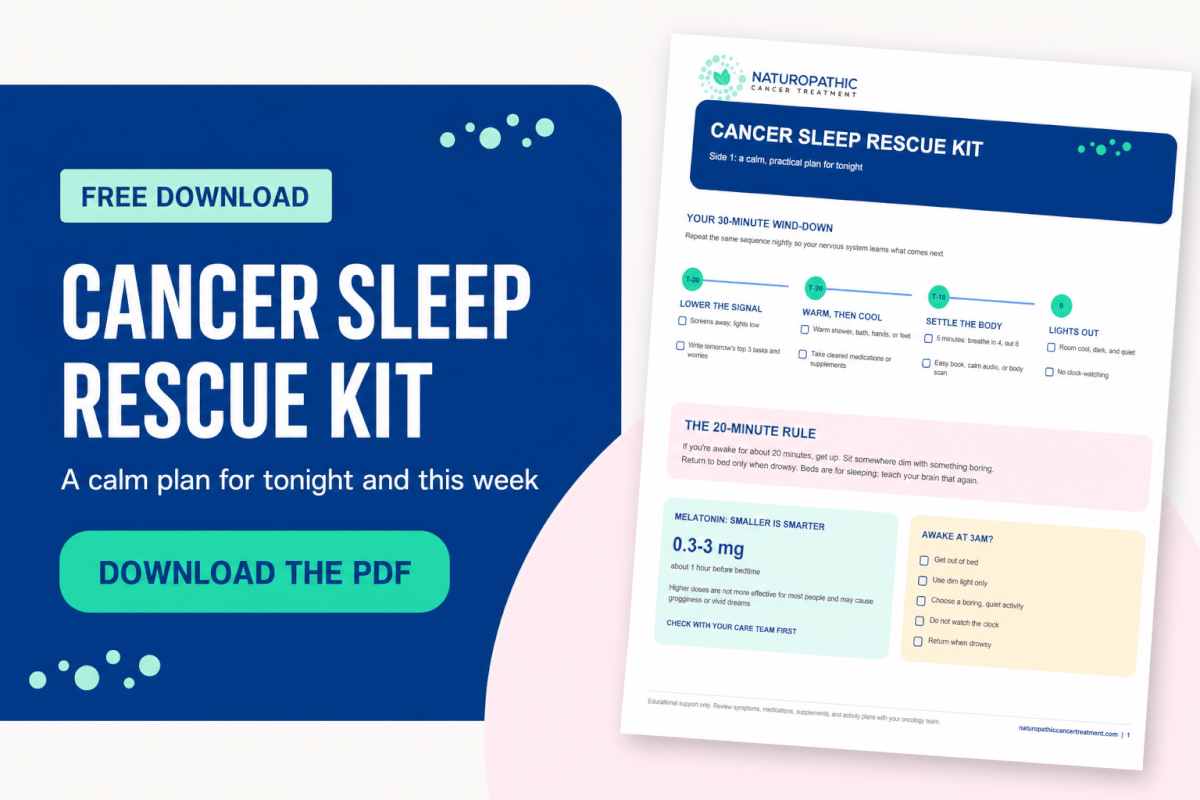
Don’t miss the Cancer Sleep Rescue Kit, a free download to put everything into action available below.
Why Cancer Insomnia Is Different
Plenty of people have trouble sleeping. But insomnia during cancer treatment has its own machinery, which is why ordinary sleep hygiene advice so often falls flat:
- Treatment drugs directly disrupt sleep. Steroids are the most notorious, but anti-nausea medications, hormone therapies, and some targeted drugs all reshape sleep architecture.
- Hormonal changes fragment the night. Hot flashes and night sweats from tamoxifen, aromatase inhibitors, ADT, or treatment-induced menopause wake you over and over, even when you don’t fully remember it.
- The body is inflamed and on alert. Cancer and treatment raise inflammatory signals that interfere with deep sleep, and the nervous system in treatment tends to idle high.
- The mind has real material to work with. This isn’t garden-variety worry. Scan results, treatment decisions, finances, family. The 3am brain picks up all of it.
The practical consequence: to fix cancer insomnia, you usually have to (1) retrain the sleep system itself, which is what CBT-I does, and (2) address your specific driver. Let’s take those in order.
CBT-I: The Treatment Your Care Team Should Mention First
The treatment name to remember is CBT-I, cognitive behavioral therapy for insomnia. It is the first-line recommended treatment for chronic insomnia in essentially every major guideline, it has been tested specifically in cancer patients and survivors with strong results, and its benefits can last after the program ends. Prescription sleep medication may still have a role for some people; that decision should be individualized with the care team.
Despite the name, CBT-I is not “talking about your feelings.” It’s a structured retraining program for your sleep system, typically 4 to 8 sessions, built from:
- Stimulus control. Rebuilding the mental link between bed and sleep (bed is for sleeping, not for lying awake doing scan math; if you’re awake more than about 20 minutes, you get up and reset). If you have dizziness, neuropathy, balance problems, weakness, or limited mobility, plan a safe seated reset with your care team rather than walking around in the dark.
- Sleep scheduling. Temporarily matching your time in bed to the sleep you’re actually getting, then expanding it as sleep gets deeper. Counterintuitive and remarkably effective.
- Cognitive work. Targeting the specific thought loops (“if I don’t sleep tonight, I can’t handle tomorrow’s infusion”) that keep the alarm system on.
- Relaxation training. Practical downshifting skills for a nervous system that’s forgotten how.
How to actually get it:
- Ask your oncology team or primary care doctor for a referral to a CBT-I trained therapist. Telehealth delivery works well, and some therapists specialize in oncology.
- Digital CBT-I programs deliver the core program by app and have good evidence behind them. Ask your care team which they recommend; insurance increasingly covers digital options.
- If access is limited, even self-guided CBT-I workbooks meaningfully help, and the wind-down protocol and scheduling principles below borrow from the same toolkit.
This is also a place where integrative care can do the connecting. Part of my role as a naturopathic oncologist is knowing which of these resources exist and helping patients actually get plugged into them, alongside the natural supports we layer on top.
What’s Keeping You Awake? Match the Fix to the Driver
Here’s where cancer insomnia gets specific, and where the generic advice fails. Find your pattern below.
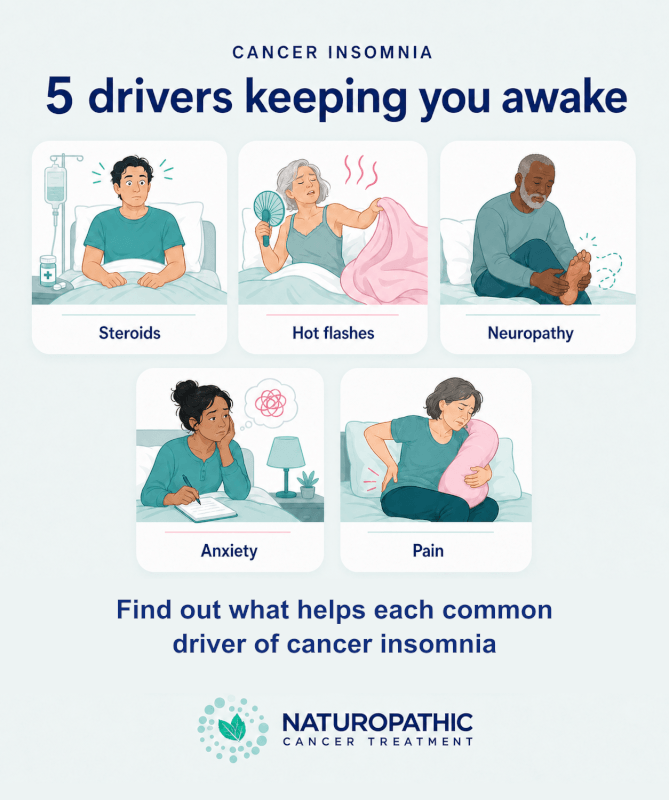
Steroid insomnia: wired at midnight after infusion days
Dexamethasone and other steroids given with chemo are famous for this: a strange, buzzing wakefulness on infusion night and the day or two after, like your body forgot how to be tired.
What helps:
- Ask about timing: “Can my dexamethasone be scheduled earlier in the day?” Morning doses disturb sleep less than afternoon or evening doses.
- If insomnia is severe, ask: “Is a shorter course or taper an option for me?” Do not change a steroid schedule on your own.
- On affected nights: keep the wind-down routine even if sleep may be imperfect.
- The next day: avoid a long catch-up nap, which can push the disruption into another night.
Hot flash and night sweat insomnia: waking soaked at 2am
Tamoxifen, aromatase inhibitors, ADT, and treatment-induced menopause all produce night sweats that fragment sleep relentlessly.
What helps:
- Tonight: use layered, removable bedding, moisture-wicking sleepwear, a fan or cooling mattress pad, and a cool room (65 to 68°F).
- This week: limit alcohol and late caffeine, which can trigger flashes.
- Consider evidence-backed options: CBT and hypnosis both have trial evidence for reducing hot flash burden; acupuncture helps some patients.
- Ask your oncology team: persistent flashes have prescription options, and an integrative consult can identify natural options that are safe with a hormone-sensitive cancer.
Neuropathy insomnia: feet that buzz, burn, or ache the moment it’s quiet
Chemo-induced neuropathy is easy to push through during a busy day and impossible to ignore at night.
What helps:
- Tell your care team: dose adjustments may matter, and your oncologist needs to know if neuropathy is progressing.
- Tonight: try loose bedding over the feet or a blanket lifter and a warm, not hot, foot soak before bed.
- Ask about topical options that are appropriate for your skin and treatment plan.
- Treat the neuropathy itself: this is a common focus in integrative oncology, not merely a sleep symptom to work around.
Anxiety and “scanxiety” insomnia: the mind that won’t clock out
The night before scans. The week before results. The ordinary nights when the what-ifs arrive on schedule at 3am.
What helps:
- Earlier in the evening: schedule a 15-minute “worry window” and write the worries down.
- At the bedside: keep a notepad so 3am thoughts have somewhere to go that isn’t your head.
- Use structured support: CBT-I targets these thought loops directly, while mindfulness and relaxation training can lower the overall alert level.
- Tell your care team if anxiety is loud most days; treating it treats your sleep.
Pain insomnia: can’t get comfortable, can’t stay asleep
What helps:
- Report pain clearly to your team; many patients minimize it, but under-treated pain is a sleep problem with a medical solution.
- Use positioning aids: pillows are underrated medicine.
- Add gentle stretching or a warm bath to the wind-down.
- Try relaxation breathing, which can lower pain’s volume even when it does not erase it.
Melatonin and Cancer: The Right Dose and Timing
Melatonin is the supplement everyone reaches for first, and almost everyone uses it wrong. Three corrections:
- The dose is smaller than you think. Your brain’s own nightly melatonin output is tiny. Doses of 0.3 to 3 mg match your physiology; the 5 and 10 mg bottles dominating the shelf aren’t more effective for most people and bring more grogginess and vivid dreams.
- Timing beats quantity. Take it about an hour before your intended bedtime. It’s a darkness signal, not a knockout pill; it tells your body clock night has started.
- Ask before you start. Melatonin is one of the better-studied supplements in oncology and is generally considered safe, but it can interact with medications, including blood thinners and blood pressure drugs. If you have a hormone-sensitive cancer, your specific diagnosis and regimen also deserve a specific answer. The MSKCC About Herbs entry on melatonin is the reference I point patients to, and a supplement review is part of every sleep consult I do.
Herbal Sleep Support: What’s Safe, What’s Not
The evidence and safety picture, which matters more in cancer care than anywhere else:
Generally reasonable to discuss with your team:
- Magnesium glycinate. This may be reasonable to discuss, but dose, timing, kidney function, gastrointestinal tolerance, and medication interactions should be reviewed with your care team first.
- Lemon balm and passionflower. Mild, calming herbs with reasonable safety profiles, usually as tea or glycerite in the wind-down hour.
- Valerian. The most-studied herbal sedative; helps some people, makes a minority groggy or paradoxically restless. If your care team agrees it is appropriate, try it only when next-day grogginess would not create a safety risk.
Approach with real caution:
- Ashwagandha. Popular for stress and sleep, but it has hormonal activity, and for hormone-sensitive cancers and patients on ADT, aromatase inhibitors, or tamoxifen, it is not the safe default it’s marketed as. This is a named caution I give frequently.
- Kava. Effective for anxiety but carries liver toxicity risk, which is disqualifying when your liver is already processing chemotherapy.
- Anything labeled a “sleep blend.” Multi-ingredient blends make interaction-checking impossible. Single ingredients, screened individually, always.
The pattern worth noticing: in cancer care, the question is never just “does this herb work for sleep?” It’s “does it work, and is it safe with this specific cancer and this specific treatment?” That second question is precisely what naturopathic oncology training is for, and it’s the heart of how I work with patients: every supplement screened against your treatment plan, in coordination with your oncology team.
Your 30-Minute Wind-Down Protocol (Start Tonight)
A consistent wind-down is the cheapest, fastest sleep intervention there is. It works because your nervous system learns the sequence: when these things happen, sleep comes next. Here’s a version to copy as-is:
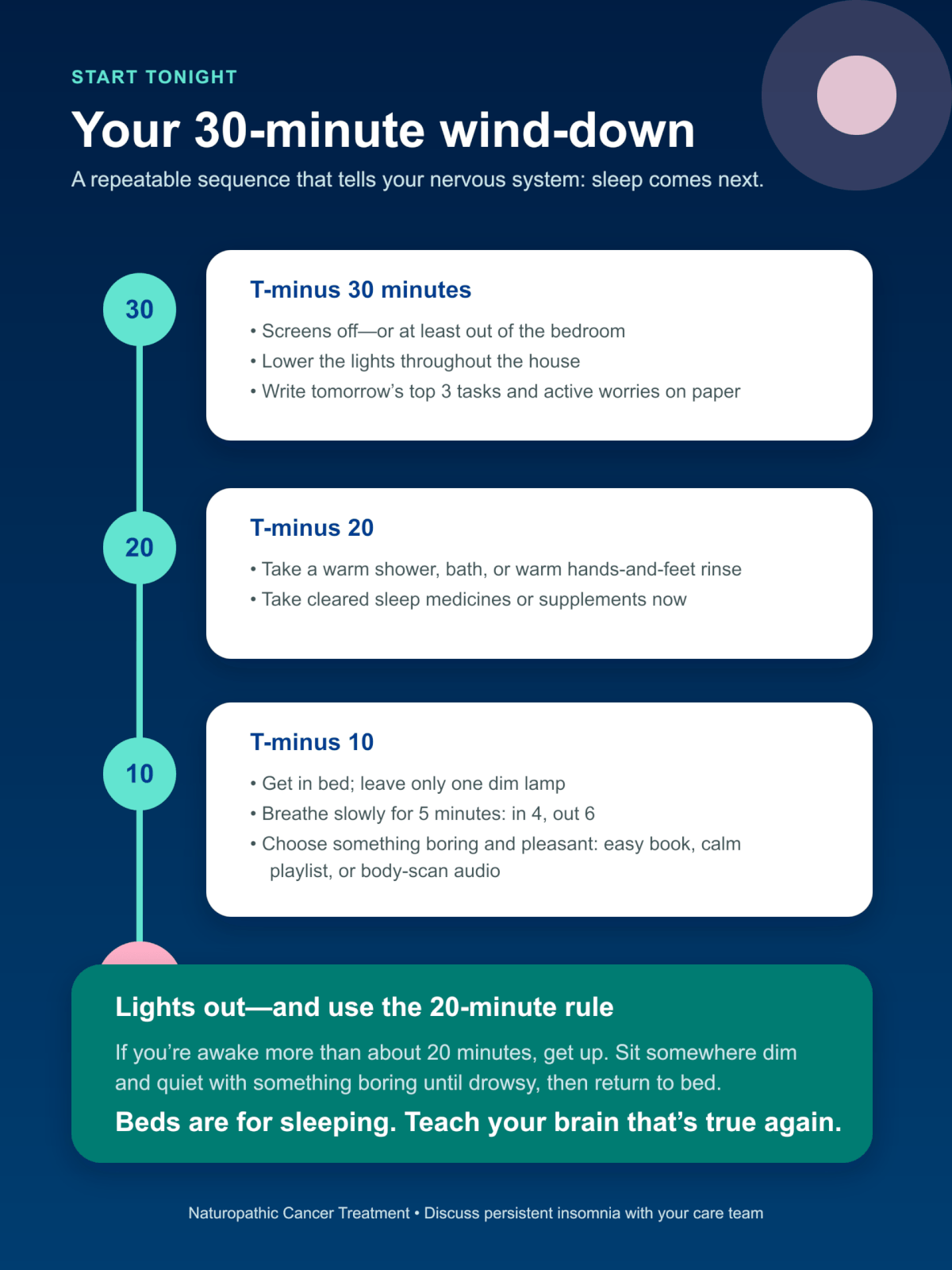
T-minus 30 minutes:
- Screens off, or at minimum out of the bedroom. (The content is more activating than the light.)
- Lights low everywhere you’ll be for the next half hour.
- Tomorrow’s top three tasks and any active worries: written down, on paper, somewhere that is not your head.
T-minus 20:
- Warm shower, bath, or just warm water on hands and feet. The body’s cool-down afterward is itself a sleep trigger.
- Sleep medications or supplements (as cleared with your care team) taken now.
T-minus 10:
- In bed, lights out except one dim lamp.
- 5 minutes of slow breathing: in for 4 counts, out for 6. The long exhale is the off-switch.
- Something boring and pleasant: a few pages of an easy book, a calm playlist, a body-scan audio.
Lights out. And the one rule that makes the whole thing work: if you’re awake more than about 20 minutes, get up. Sit somewhere dim and quiet with something boring until drowsy, then return. If you have dizziness, neuropathy, balance problems, weakness, or limited mobility, do not walk around in the dark; use a safe seated reset planned with your care team, or stay in bed and use a calm, low-stimulation activity. The goal is to rebuild the bed-sleep connection without creating a fall risk.
When to Bring In More Help
Some sleep problems need more than habits and herbs:
- If you snore loudly, gasp or stop breathing during sleep, or wake unrefreshed no matter how long you sleep, ask about a sleep apnea screen. Apnea is common, treatable, and dramatically underdiagnosed in oncology, where its symptoms get filed under “cancer fatigue.” A home sleep study is often all it takes.
- If insomnia persists 3 nights a week for 3 months or more, that’s chronic insomnia by definition and deserves dedicated treatment (usually CBT-I), not endurance.
- If low mood, hopelessness, or anxiety are growing alongside the sleeplessness, tell your care team. Depression and insomnia feed each other, and treating one helps the other.
- And if you want a guide through the whole landscape – the cause-matching, the supplement safety, the CBT-I referral, the conversation with your oncologist about steroid timing – that’s exactly what an integrative sleep consult is for. This is some of the most rewarding work I do, because sleep is upstream of nearly everything else: fatigue, brain fog, mood, pain tolerance, even how well you bounce back between treatment cycles.
For the foundational habits that make all of this stick, my guide to optimizing sleep during cancer treatment is the companion piece to this one.
Tonight, Then Tomorrow
Tonight: run the 30-minute wind-down. If melatonin, prescription sleep support, or another supplement is part of your plan, use it only as coordinated with your care team. If you are awake at 3am and steady on your feet, move to a dim, quiet, safe place until drowsy. If dizziness, neuropathy, weakness, balance, or mobility is a concern, use a seated or in-bed reset that does not create a fall risk. Be kind to yourself about it; one bad night costs you less than the worry about it does.
Tomorrow: figure out your driver and start the conversation—with your oncology team about steroid timing or a sleep study, with a CBT-I therapist about retraining the pattern, or with me for an integrative plan that matches likely causes and screens supplements against your treatment.
Schedule a virtual consult for cancer insomnia and sleep support with Dr. McMurry:
Frequently Asked Questions About Cancer Insomnia
Why can’t I sleep during chemo?
Chemotherapy disrupts sleep through several routes at once: steroid medications given with infusions, inflammation that interferes with deep sleep, anti-nausea drugs that alter sleep architecture, and the anxiety load of treatment itself. Insomnia on and after infusion days is especially common and often traces directly to dexamethasone timing, which your oncology team can frequently adjust.
What is the best treatment for insomnia in cancer patients?
CBT-I (cognitive behavioral therapy for insomnia) is the first-line treatment, with strong evidence specifically in cancer patients and survivors. Its benefits can persist after the program ends. Prescription sleep medication may still have a role for some people; treatment should be individualized with the care team. CBT-I is available through telehealth therapists and evidence-based apps.
How much melatonin should a cancer patient take?
Melatonin dose and timing should be individualized. Lower doses are often sufficient, but the right approach depends on your medications, cancer type, treatment plan, symptoms, and fall risk. Review it with your oncology team or a naturopathic oncologist before starting.
Is ashwagandha safe during cancer treatment?
Not as a default. Ashwagandha has hormonal activity, and for hormone-sensitive cancers (and patients on tamoxifen, aromatase inhibitors, or ADT) it deserves a specific safety conversation rather than an assumption. Other calming options may also interact with treatment or add sedation, so review any supplement with your care team rather than assuming it is safer.
Does tamoxifen cause insomnia?
It can. Tamoxifen commonly triggers hot flashes and night sweats, which repeatedly interrupt sleep even when you do not remember every awakening. Aromatase inhibitors can cause the same pattern. Treating those symptoms and using CBT-I when insomnia persists are more effective than relying on generic sleep hygiene alone.
Does insomnia after chemo go away?
Often, but not automatically. Sleep commonly improves as treatment effects fade, but insomnia has a habit of outliving its original cause, because weeks of bad nights train the brain into a new pattern. That’s why chronic post-treatment insomnia responds so well to CBT-I, which retrains the pattern directly.
Why do steroids cause insomnia?
Steroids like dexamethasone mimic cortisol, your body’s main alertness hormone. A dose late in the day essentially tells your brain it’s morning. Taking steroids earlier in the day, with your oncology team’s blessing, is often the single highest-impact fix for infusion-week insomnia.
References
- Edinger JD, Arnedt JT, Bertisch SM, et al. Behavioral and psychological treatments for chronic insomnia disorder in adults: an American Academy of Sleep Medicine clinical practice guideline. Journal of Clinical Sleep Medicine, 2021. CBT-I as first-line treatment.
- Savard J, Ivers H, Villa J, Caplette-Gingras A, Morin CM. Natural course of insomnia comorbid with cancer: an 18-month longitudinal study. Journal of Clinical Oncology, 2011. Prevalence data behind the “roughly half” figure.
- National Cancer Institute. Sleep Disorders (PDQ) – Patient Version. Plain-language source for the same prevalence figure.
- Garland SN, Carlson LE, Stephens AJ, et al. Mindfulness-based stress reduction compared with cognitive behavioral therapy for the treatment of insomnia comorbid with cancer: a randomized, partially blinded, noninferiority trial. Journal of Clinical Oncology, 2014. CBT-I tested in cancer patients.
- Elkins G, Marcus J, Stearns V, et al. Randomized trial of a hypnosis intervention for treatment of hot flashes among breast cancer survivors. Journal of Clinical Oncology, 2008.
- Mann E, Smith MJ, Hellier J, et al. Cognitive behavioural treatment for women who have menopausal symptoms after breast cancer treatment (MENOS 1): a randomised controlled trial. Lancet Oncology, 2012.
- Carlson LE, Ismaila N, Addington EL, et al. Integrative oncology care of symptoms of anxiety and depression in adults with cancer: Society for Integrative Oncology-ASCO guideline. Journal of Clinical Oncology, 2023. Mindfulness and relaxation for anxiety.
- Memorial Sloan Kettering Cancer Center, About Herbs: Melatonin, Valerian, Ashwagandha.
- National Heart, Lung, and Blood Institute. Sleep apnea: NHLBI sheds light on an underdiagnosed disorder.
- Cancer Research UK. Difficulty sleeping.
—